

Embodied carbon: the number specifications are learning to ask for
For twenty years, the sustainability conversation in Irish building was about operational energy: insulation, airtightness, heat pumps, BER certificates. That work mattered and still does. But as operational performance improved, a second number came into focus — the carbon emitted making the building in the first place.
Two kinds of carbon
Embodied carbon is everything that happens before the lights go on: extracting raw materials, manufacturing products, transporting them and assembling them — plus, over the building's life, maintaining and eventually disposing of them. For a new, energy-efficient building, embodied carbon can account for half or more of its total lifetime emissions. A building that is cheap to heat but expensive to make, in carbon terms, is only half an answer.
This is why the Royal Institute of the Architects of Ireland set embodied carbon targets in its 2030 Climate Challenge, and why UK-based LETI ratings increasingly appear in Irish specifications. The RIAI's current non-domestic benchmark sits at 1,000 kg CO₂e/m²; its 2030 target is 540.
A measured example
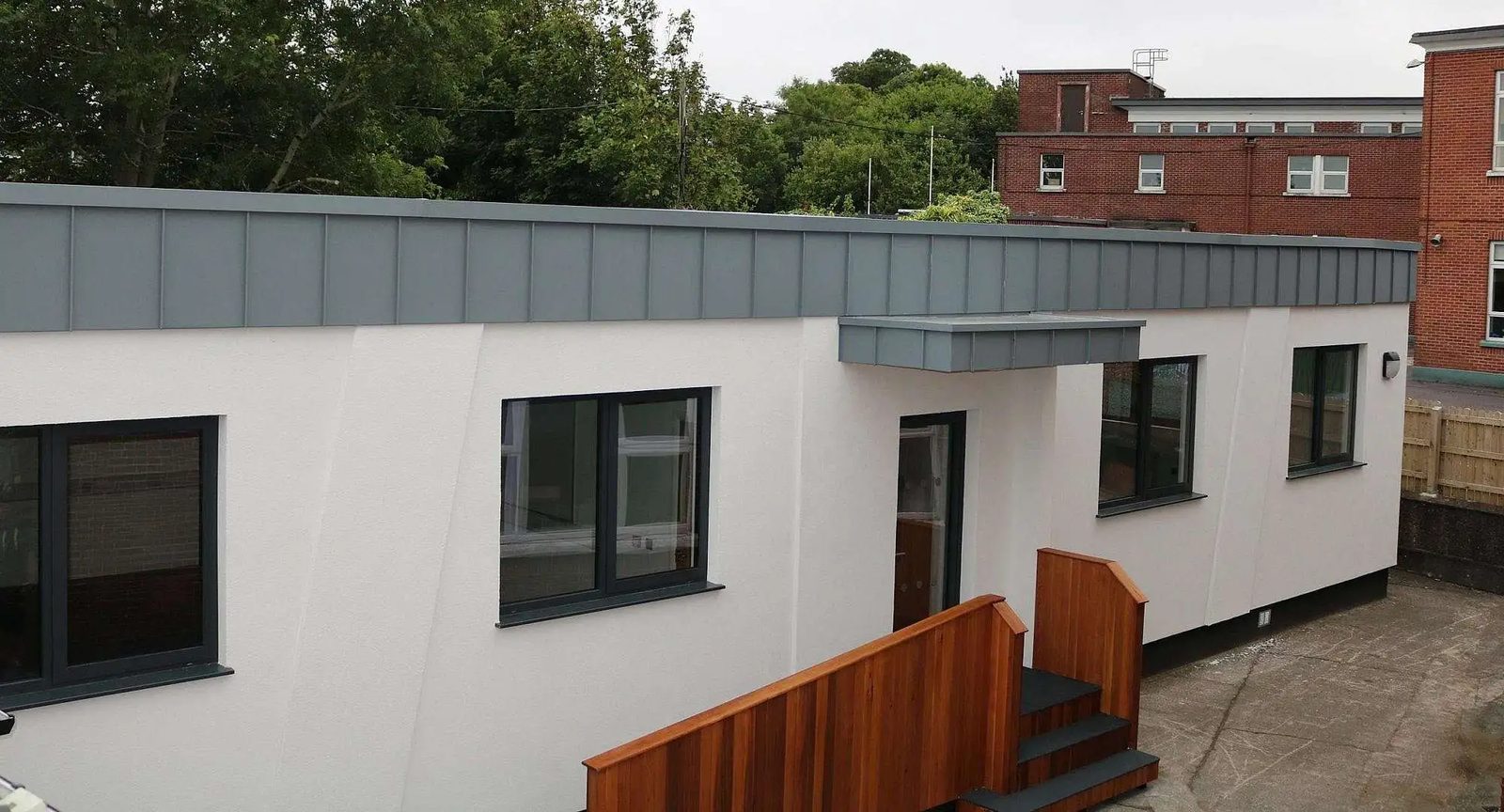
In 2021 Lidan delivered a modular school building — four classrooms and two offices — for St Patrick's College in Cork. Sustainable building consultant John Butler assessed it using PHribbon and arrived at 249 kg CO₂e/m²: an A+ LETI rating for both upfront and whole-life carbon, and less than half the RIAI's 2030 target, achieved nine years early. The result was reported by Passive House Plus.
How a number like that happens
No single decision gets a building to 249. It is the compound effect of many: a structural frame of FSC-certified timber rather than steel or concrete, which stores carbon instead of emitting it; cellulose and wood-fibre insulation instead of petrochemical foams; a factory process that cuts material waste to a fraction of a conventional site's; and ground screws that can remove concrete foundations from the bill of quantities altogether.
For specifiers, the practical advice is simple: ask for the number. Request an embodied carbon assessment against the RIAI 2030 targets at tender stage, and ask what evidence sits behind it. The gap between buildings that measure and buildings that estimate is, in our experience, the most revealing line in any submission.