

Prefab or permanent? What €1.3bn of school accommodation spending actually tells us
In June, the Irish Examiner reported that the Department of Education spent €1.3 billion between 2020 and 2025 on rented land, rented buildings and modular accommodation. Of that, €222 million went on rent alone. The modular programme itself accounted for €1.14 billion, delivering 595 completed projects since 2021 at a reported cost of around €367,000 per primary classroom unit, excluding VAT.
The reporting framed the figure as a story about "prefabs" and "temporary fixes". The Department pushed back, describing modular accommodation as an investment in permanent accommodation delivered through modern methods of construction — "not temporary accommodation". An opposition spokesperson countered that temporary measures were never meant to become a substitute for proper planning.
Both positions contain something true. The confusion sits in a single word.
One word, two very different buildings
"Prefab" is doing too much work in this debate. It is used to describe the rented steel-and-panel units that generations of Irish students remember — cold in winter, warm in summer, still on site twenty years after they were meant to leave. And it is used, in the same breath, for permanent factory-built schools with structural timber frames, natural insulation and design lives measured in generations.
These are not points on the same spectrum. A rented temporary unit is priced, insulated and detailed for a short stay, and the €222 million rent figure shows what happens when short stays quietly become long ones. A permanent factory-built school is simply a school — one whose construction happened to take place indoors, under quality control that a rain-soaked site cannot match.
The distinction the Department is reaching for is real. But it will only stick if it is made measurable — and it can be.
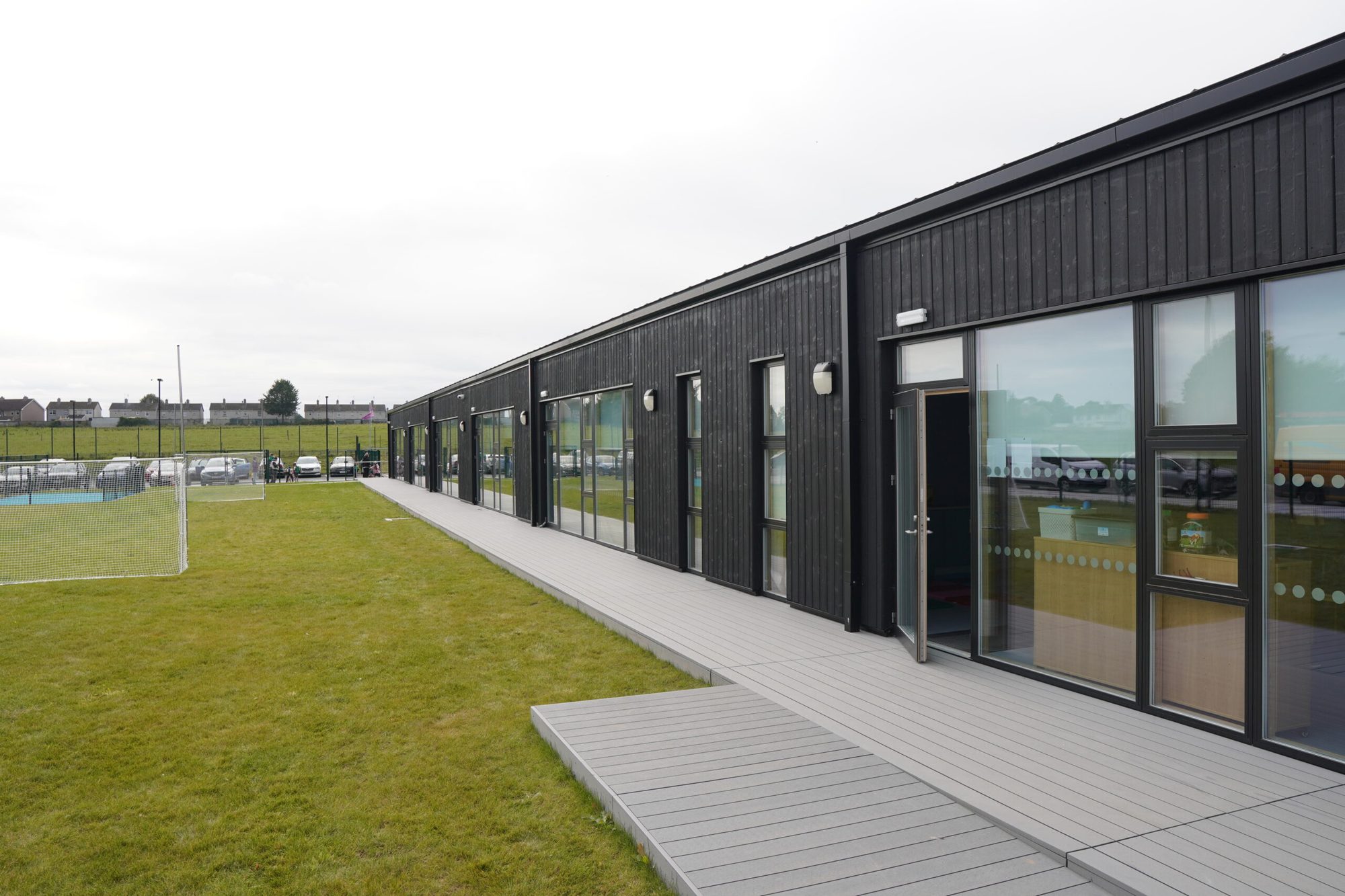
Permanence is measurable
A building's status as permanent or temporary is not a matter of assertion. It shows up in numbers that any specifier can request at tender stage.
Airtightness is one. Gaelscoil na Laochra in Birr, a 1,000 m² school we completed in 2024, tested at 0.64 air changes per hour — effectively at the passive house benchmark of 0.6, and far beyond what any temporary unit is detailed to achieve. That single number is why the school costs in the region of €91 a month to heat, a figure reported by Passive House Plus in its April 2025 feature on the project.
Embodied carbon is another. Birr came in at 488 kg CO₂e/m², against the RIAI's current non-domestic benchmark of 1,000 kg CO₂e/m² and its 2030 Climate Challenge target of 540. St Patrick's College in Cork, an earlier project, measured 249 kg CO₂e/m² and achieved an A+ rating under the LETI scale. A building bought as a stopgap is rarely asked for these numbers at all; a permanent building should not be bought without them.
Energy rating, structural material and foundations complete the picture: an A-rated BER, NZEB and Part L compliance, FSC-certified structural timber rather than sacrificial panelling, and foundations designed for the building's whole life. None of this is exotic. All of it is specifiable.
Speed was never the problem
The appeal of modular accommodation to a Department facing enrolment pressure is obvious: children need classrooms in September, not when a traditional programme concludes. The mistake is assuming that speed and permanence trade off against each other.
St Flannan's College in Ennis suggests otherwise. Its 2,500 m² special educational needs building was 87% prefabricated before arriving on site in September 2024; students were in the building by September 2025. The Irish Post described the project as a template for rapid builds. Nothing about that timeline required the building to be temporary — roughly 92% of the build value was completed in our factory in Roscommon, which is precisely what made the site phase short.
Renting buys speed and pays for it indefinitely. Building permanently offsite buys the same speed once.
What specifiers can ask for
For public bodies weighing accommodation options, the practical lesson of the €1.3 billion figure is not that factory-built construction is suspect. It is that the paperwork should force the distinction the word "prefab" blurs. Ask for a measured airtightness result, not a design intention. Ask for a calculated embodied-carbon figure against the RIAI benchmarks. Ask for the BER, the design life, the insulation specification and the certification of the structural timber. A temporary unit cannot answer those questions well. A permanent building can — and when it does, it stops mattering where it was built.
That is the standard we work to, and the one we would encourage every specifier to write into the next tender.